The kiosk touch problem, stated plainly
A kiosk needs touch that survives the public: gloves in winter, queues at noon, a cleaner with a spray bottle at night. The manufacturer's own catalogue names the territory — query terminals, cash registers, self-service machines — and its application list for the frame programme includes exactly those uses. In practice, kiosk integrators choose between three artefacts from this catalogue, and the right choice is decided by what the kiosk already contains.
The three kiosk specifications
1. Infrared overlay on a commercial display
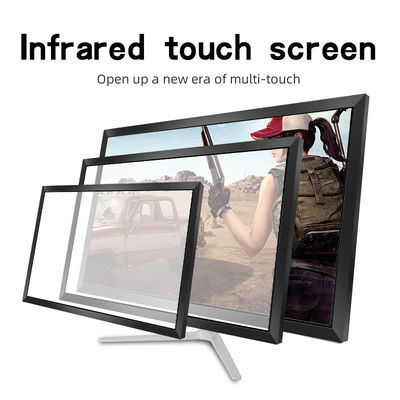
The default. A frame sized to the display (the 43-inch LV-43 kit is the reference build) gives 20 touch points, glove operation, and a panel that can be swapped in the field without touching the touch layer. Sizes from counter-top 15-inch frames to 55-inch furniture terminals follow the same logic.
2. Open-frame touch built into the carcass
For kiosk manufacturers building their own housings, open-frame kits and metal-case panels (the catalogue's ATM/POS/open-frame-machine listings) disappear into the furniture. This is the fleet route: one engineering effort, repeated across every unit.
3. Touch foil behind the kiosk glass
Where the design demands a single uninterrupted glass front — premium retail, transit information, through-window service — capacitive touch foil laminates behind the pane. No bezel, nothing to prise off, and the interaction surface is the glass itself.
Signage that invites a touch
Digital signage touch screens live a double life: attract loop by day, interactive catalogue when a customer steps up. The overlay families here cover the sizes signage actually deploys — 43, 55 and 65 inches — with the multi-touch headroom for two users at a wayfinding screen. Declare portrait or landscape at inquiry; frame cable exits and profile joints are placed accordingly.
Whichever artefact you choose, the inquiry that gets a useful quotation contains: housing or display model, mounting orientation, indoor or storefront exposure, and fleet quantity. Send those four facts and the reply is a specification, not a brochure.