CATALOGUE TO 98″ · CUSTOM TO 500″ · SPLICING SUPPORT
Touch at architectural scale
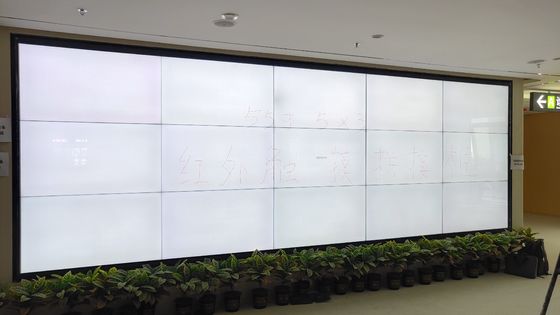
Large format touch is where infrared sensing has no serious rival: the frame programme in this catalogue runs to 98 inches as standard product — the LV98-17MM is a listed, priced model class, not a concept — and the same frame design is supplier-specified for sizes from 15 inches to 500 inches, which is the splicing regime: multiple frame segments building one continuous touch field across a video wall or an exhibition surface. At these sizes the engineering questions change. Nobody asks whether it senses touch; they ask how the profile ships, how segments join without a dead band, how calibration holds across a wall that is not perfectly flat, and what a service call looks like on a 4-metre frame. This page answers in those terms.
Specification pattern — large frames
| Off-the-shelf ceiling | 98″ catalogue frames (LV98-17MM, 20 points) |
|---|---|
| Custom range | Frame programme supplier-specified 15″–500″ |
| Touch points | 20 points standard on large catalogue frames; platform specified to 64 |
| Sensing resolution | 32768 × 32768 (supplier-stated) |
| Structure | Aluminium alloy profile, segmented for transport on spliced builds |
| Stated applications | Video wall, exhibition, splicing screens (company profile wording) |
| Minimum order | 1 piece |
Splicing, honestly described
A spliced touch wall is a system, not a frame: the sensing field is continuous, but the wall beneath it is made of panels with bezels, mounted on a structure with its own tolerances. The catalogue lists a dedicated splicing touch frame in the panel family and a 93-inch DIY frame explicitly positioned for video wall use — evidence the manufacturer builds for this regime — but the success of a spliced install is decided by wall flatness and by the calibration procedure, both covered in our splicing and calibration notes and the video wall application page. Declare the wall construction (panel model, count, layout) in the inquiry; large-frame quotations are drawing-led, and the drawing is where splicing projects are won.
Where large frames are specified
Exhibition and brand walls, control-room overview displays made interactive for briefings, museum and showroom surfaces, and education feature walls beyond whiteboard sizes. Below 98 inches, also price the simple answer: a single catalogue frame (the 65-inch and the 98-inch class) covers most "large" briefs without entering splicing territory at all.
A note on evidence
Every figure on this page traces to the manufacturer's own catalogue listings for this model class — dimensions, touch points, interface and stated standards are quoted from those listings, and anything the listings leave open (certification documents for a specific build, confirmed lead time for a specific quantity) is confirmed at quotation rather than filled in here. That discipline is deliberate: a specification page that invents nothing is the only kind worth engineering against, and it is why the inquiry asks for your display model — so the reply can be written against your unit, with the drawing, instead of against a generic diagonal.
How does a 98-inch frame ship?
In profile segments with the PCBA and leads, for on-site joining — which is precisely why freight damage and handling are simpler than for a one-piece glass panel of the same size. Confirm packaging against your freight route in the inquiry.
Can a spliced frame follow a curved wall?
Curved sensing is a foil speciality at moderate sizes (a curved foil build is listed in the foil family). For very large curved surfaces, declare the radius in the inquiry for a per-project answer.